miércoles, 4 de mayo de 2016

Real Madrid 1 - Manchester City 0. Real advances to another Spanish UCL Final


The moment I saw that Clichy was starting in the leftwing of Manchester City I realized that Manuel Pellegrini was trying to play his defensive cards.

With a 0-0 draw on the first leg played in Manchester, City only needed one goal to complicate Real Madrid's life. Yet, the chilean coach clearly was more concerned about Real Madrid not scoring.

Ronaldo himself has scored 17 goals in the UCL this season, and Real Madrid sits in third position of La Liga with an astonishing 105 goals for, the highest in the competition. That means that Real Madrid WILL score. It will be a matter of minutes, but its quite rare that Zidane's team concedes a clean sheet to whoever they are playing with.

A more realistic approach would have been to assume that Madrid would score, and try to complicate their lives by scoring as many goals as possible, at least one.

Lets say that City scores first. With 0-1 anxiety will appear in the Bernabeu and maybe then Manchester City will have a chance.

Even though the first ten minutes the English team had control of the ball, Modric and Isco started overpowering Yaya Toure and Fernandinho in the midfield. Madrid gained control of the ball and Manchester were just hanging on there.

Navas was playing extra deep to keep Marcelo out of attacking positions (nice move by Pellegrini), but the danger was coming from the right side of Real Madrid's attack. De Bruyne's defensive effort is imaginary, since he does not really bring anything to the table in that matter. With Marcelo deep back taking care of Navas, Real Madrid played more through the right side, where Carvajal had no problem getting rid of De Bruyne every single chance.

After 20 minutes, one of those plays ended up with a nice pass from Carvajal to Bale, a shot from the welsch and the ball in Hart's net after deflecting in a defender. 1-0 for Real Madrid.

Manchester City shot 3 times on goal, none of them on target. Keylor Navas had a very pleasant afternoon, and the few chances that he had to go to work, he was extremely secure. He will not make a humongous save to save the day like Casillas used to do, but he will not make any mistakes when it is his turn to shine.

In order to help Marcelo, Zidane got Jese to play a bit more towards the left side to prevent the City getting an easy start of the play there and looking for Navas.

Time was passing and Manchester City did not create any chances (I am not suprised when your midfield is pure muscle and 0 creativity) so Pellegrini finally put some of the talent that he had in the bench in the pitch, getting Sterling and Kelechi Iheanacho on. Sterling brought a bit of something through the left side, but was never able to create real chances.

Real Madrid advances to the final too easily to face Atletico de Madrid, in a match that will be much more complicated than this semifinal.

We will have the same final than in 2014, when a late header by Ramos prevented Atletico de Madrid from winning their first ever UCL. 

One thing is for sure: Simeone will not make the game as easy as Pellegrini did today. It will be a very enjoyable battle.

jueves, 23 de julio de 2015

Failure in the CONCACAF Gold Cup 2015


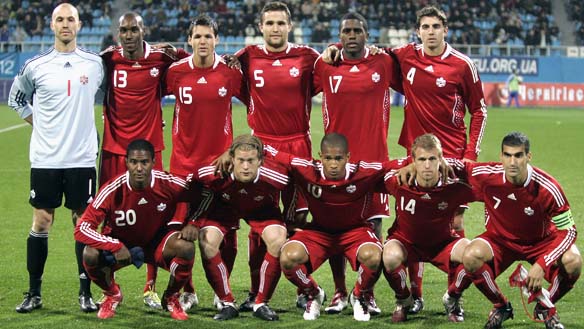
Canada left the 2015 CONCACAF Gold Cup after being unable to score once in 270 minutes of play, drawing two games and losing one, to end up 4th in Group B and exit the competition with a feeling of disappointment that hopefully, will not go all the way through into the World Cup 2018 Qualifiers that lie ahead.

Canada was held to a scoreless tie against the weaker side of the group, El Salvador, in a game that started to raise some questions about Benito Floro's coaching decisions. Cyle Larin missing an empty netter in the 36th minute is an example of how hard it is for this Canadian team to capitalize the few chances that they create.

Vicente Cantatore said once "Soccer, if you don't actually score, becomes much more difficult to play".

Canada held a higher possession, but yet, shot less than El Salvador, who started up with a lot of pressure against the Canadian defense, and ended up controlling the major part of the game in the second half, but without really creating clear chances. If anything, Canada had the best chances, but yet, remained unable to score once.

Floro finally got Osorio and Teilbert into the pitch, but only with less than 10 minutes less. He failed to understand that, right now, those two guys are probably the best players in the squad, and yet, as if he underestimated El Salvador, none of them started the game. Even worse is that it took him 83 minutes of play to finally realize that he was wrong. Placing Akindele as a winger was just the icing in the cake of his mistakes. He needs to play as a striker, otherwise his talent is lost and we are facilitating the job of the opponent defense.

Things got even worse in the second game, against Jamaica. Despite having the ball for longer than the Reagge Boyz, Canada was largely surpassed in number of shots by the most physical Jamaican team (21-7). Austin's goal in the 91st minute ended Canada's clean sheet record and, to be honest, put a more fair end to a game where Jamaica played better in general terms. And guess what, Akindele was playing as a winger yet once more, Teilbert played barely 19 minutes and Osorio didn't even step in the game.


Game 3 against Costa Rica was yet another offensive dissapointment, yet the team presented some improvements. Osorio was a starter, Teilbert not, but the played after and finally Floro understood that Larin was not adding anything to the team, so he placed Haber as a striker. Every ball he touched, he did something good. So far I think that Akindele should be starting in that position (something that Floro has yet to understand), but if the MLS Rookie of the year is not to play the game, Haber is the better option over Larin. He moves well, he has body enough to keep the ball while the wingers take positions and he plays it smart. He knows what he can and what he cannot do, and he acts accordingly. I really liked his participation in the game, even though Canada could not get the goal that would end the horrible scoreless strike and send them to the quarterfinals.  It was the first game where Canada did not hold the possession of the ball more than the opponent, but that was expected against Costa Rica.

In the end, with the final whistle, Canada was eliminated, scoreless and clueless about what the style of the team should be. That is quite worrying if we think about the 2018 Qualifiers. The third round will be a serious test for the National team. A home and away game is a very dangerous thing if you are not able to score.

Proof that the team is still trying to find its identity is that Floro passed from a 4-3-3 formation against El Salvador to a 4-1-4-1 in the two next games. However, if the core of your midfield is in a 4-1-4-1 are the three players in the middle, you are clearly telling your opposition that you will play defense when 2 out of those 3 guys are stoppers (Straith and De Guzman).

That formation works much better when the guy playing between the midfield and defense is a stopper, but the two guys playing in front of him are more creative. There are thousands of examples that come to mind.

Claude Makelele was sweeping behind Zinedine Zidane in Real Madrid and France team, and it worked wonders in both cases. One was focused on stopping, the other one in creating.

Sergio Busquets took care of everything behind Xavi and Xabi Alonso for Spain between 2008-2012, when the Spanish team won the Triple crown.

Obviously and sadly, Canada do not have players that can compare with those, but if the main problem of your team is the offense, at least try to put a stronger attacking team in the pitch.

In any case Canada has to figure things out before August 31st, when the Qualifiers for Russia 2018 are resumed.

jueves, 2 de julio de 2015

CONCACAF GOLDEN CUP 2015, the next challenge for the Canadian soccer team


Good news for the soccer fans! Right after the end of the Women's World Cup on July 5th, we will only have to wait one day until another major tournament starts. In this case, it will be the 23rd edition of the CONCACAF GOLD CUP, the regional championship for the federations of North and Central American and the Caribbean.

The format will be the same that we are seeing these days in the America Cup. three groups of 4 teams each, with the two best teams on each groups advancing to the Quarterfinals, accompanied by the best two third seeded teams.

Now I did not see a lot of all the teams taking part in the competition lately, but my gut is telling me that there are three main candidates to lift the trophy in Philadelphia on July 26th.

1- United States: How this team has evolved in the past 20 years still amuses me. From being one of the teams that all of us wanted to get drawn with in a World Cup, to a serious rival that could beat almost any team in the World. How did they manage to achieve such wonderful transformation? I bet you anything the creation of the MLS has something to do with it. All of a sudden the country has a strong competitive league where the local players can really develop, and it's expanding and getting better every year. I don't know how long it will take for the US to get one of those little stars just over the national team shield in the shirts that means that country has won a world cup, but I trully believe they will get one sooner than later (ok, lets say 12-18 years from now). Jurgen Klinsmann is regenerating the team  with new blood constantly (he brought Julian Green to the World Cup when he was 18 and he paid him back with a nice goal), and when you see the teams where the US players are actually playing, not all of them are in the MLS. The list could form a quite interesting group in any upcoming UEFA Champions League (Aston Villa, Hertha, Bolton Wanderers, Borussia MG, Eintrach Frankfurt or AZ, for example). I personally enjoy like a kid when Bradley distributes the ball, helped by Beckerman to reach either Clint Dempsey or Jozy Altidore. The States are a very serious team, and they should lead the way in Group A over the rest, with Panama and Honduras trying to get the second place and Haiti enjoying the experience. A nice fact that generally passes unnoticed is how Klinsmann has two other ex players helping him as assistants, both of them with World Cup appearances in their CV: Tab Ramos and Andreas Herzog. Ring a bell?

Jurgen Klinsmann, World Cup winner

2- Costa Rica: Drawn with Italy, England and Uruguay in the past World Cup, I was one of the first to say that they would go home after three games. Needless to say that them reaching the quarterfinals and getting kicked out only in the penalty shots by the Nederlands was a very refreshing surprise. Names like Bryan Ruiz, Joel Campbell or Jose Miguel Cubero are already having a nice career in Europe. But what impresses me most of Costa Rica is how they move, behave, act and compete as a team. No one is above the rest. They defeated Uruguay and Italy in the last World Cup because they simply though they could, and they played accordingly. A tie with England led the way for two other ties, against Greece and the Nederlands in the knockout stage. Costa Rica left the last World Cup undefeated, after facing three World champions (Ururuay, Italy and England) and two EuroCup winners (Greece and the Nederlands). In a much less competitive environment, they only problem that I foresee is if the players get too comfortable. They need to play against El Salvador or Canada as they played against England or Italy. If they do so, they could dream of being in the finals.

Bryan Ruiz playing for Fulham


3- Mexico: If they decide to play a 4-3-3 scheme, just read the three strikers they could line up in any game: Chicharito Hernandez, Carlos Vela and Giovanni Do Santos. Wow!. Just wow!. They have probably the most experienced squad at International level and that is something that gives them a good advantage against teams that generally don't see themselves in the Finals very often. They should lead their group and then see when Costa Rica or the States will cross paths with them.

Chicharito playing for Manchester


So if I have to predict what is going to come down to, this would be my bet:

Group A

United States will lead the way with Honduras being second. Panama will be third.

Group B

Costa Rica will clinch the first position, Jamaica being second and Canada being third.

Group C

Mexico will cruise to the first position, with Trinidad & Tobago second and Guatemala third. Guatemala will be the worst third seeded team, so Canada and Panama will clinch a spot in the Quarterfinals, that would look like this:

United States - Canada
Costa Rica - Honduras
Mexico - Panama
Trinidad & Tobago - Jamaica

The semis would be United States - Costa Rica and Mexico - Jamaica, with the States and Mexico advancing to the final.

Players to keep an eye on:

- Deandre Yedlin (United States): Young, but talented. If he has minutes, he can perform.
- Aron Johansson (United States): With Dempsey getting old and Altidore not quite performing as expected, the States need a young striker that could capitalize some chances. The AZ striker could be that man.
- Andy Najar (Honduras) The Anderletch midfielder bring some talent to the pitch each time he plays.
- Joel Campbell (Costa Rica). He is supposed to have a huge potential. Did not really crack open just yet. Right now for a lot of experts he is in that moment of his career where he could finally explode to be a star, or just fall apart and be forgotten.
- Michael Seaton (Jamaica). The Orebro striker is only 19 years old but he has already 12 caps and 2 goals with the Reagge Boyz. Interesting prospect.

Now sit back and enjoy the football!!!

miércoles, 3 de junio de 2015

Argentinan relegation system vs standard relegation system


These past days I have been studying the, somehow, controversial relegation system created in Argentina.

For those of you who are not familiar with it:

In the Argentinian League there are 2 teams directly relegated to National B, and two other teams that will enter a play out game against two teams from the National B division. However, which team is relegated is not decided entirely by the standings of the season.

They use an "average system" which is calculated by dividing the number of points that the team got in the past three seasons and divide it by the number of games that team played in those 3 seasons. The two teams with the worst average at the end of the season are directly relegated to the National B and the champions and the runner up of National B take their place for the next season.

The 3rd and 4th teams with worst average would enter then the play out games against the 3rd and 4th seeded in the National B division. It is a home and away system. Winners will win their right to play in the First Division next year.

Now, this has been very controversial since it's inception in the 80's. People say that the system was invented to clearly help big teams to not get relegated ever. But if we look at the statistics, all major Argentinian teams have been relegated with this system. The biggest example is River Plate in 2011, and the latest is Independiente in 2013.

Here is a link on how each team sits right now in the Argentinian Relegation system:

http://espndeportes.espn.go.com/futbol/descenso?league=arg.1

Main detractors of this idea say that it is not fair that your team can end in the 12th position, but yet, be relegated because they have one of the worst average points per game.

In my opinion, it is a very fair system. Think of those boring games at the end of the season between teams in the middle of the table, with no option of qualifying for any international tournament, and not threatened by the ghost of relegation. Those games are really boring to watch, and to play.

However, with this system, the more points you get each season, the more peace of mind you will have towards a future relegation. River Plate made a brilliant campaign in 2008. However, their season in 2009 and 2010 were not that brilliant.

They found themselves with one of the worst averages for the 2011 season, and their performance in that season was nothing worth remembering either. They ended up with the 4th worst average and they had to face a promotion against Belgrano. Eventually, they ended up losing in Cordoba (2-0) and getting a futile tie back in Buenos Aires (1-1) that sealed their faith sending one of the most famous teams in the World to the National B.

Now I don't know if a system like this would have any success in Europe. I believe that in those leagues where the money prizes are not equally divided (Spain is the best example), this system would bring some extra salsa to the last games of the season, when teams are in the middle of the standings. Right now, in Spain, it doesn't really matter that you end up in the 8th position or in the 17th, you basically get the same amount of money, which is stupid.

That is why teams don't really care about the results at the end of the season when it is clear for them that they will not be relegated nor play in Europe next season. That is avoided in England, because the higher you end in the Standings, the more money you make, so it is quite important to finish as high as possible in the standings.

But other leagues like Italy or Spain, could adopt this system and make the competition a bit more interesting!. I doubt Real Madrid or Barcelona could EVER get relegated, but look at Milan or Inter this past season. Mediocre, for teams that big. They could be in trouble in a couple of years from now if they keep ending 10th or 11th.

Anyways, all in all, not a bad system, even though we will not see it being used other than in South America, I am afraid.

lunes, 30 de marzo de 2015

The first obstacle on the road to Russia 2018


The way to Russia 2018 will start for the Canadian National Team on June, when Benito Floro's team faces Dominica in a two legged elimination game.

Even though most people may think that the games against Dominica should be a piece of cake for the Canucks, in my opinion there is more than a shadow of a doubt about that.

Canada has better players on the paper, and the team has more international experience. The presence of several Canadian teams in the MSL is undoubtedly helping the development of talented young players, who are more accustomed to play in a much more competitive environment than the Dominican League, where the major part of the players of Dominica play.

However, in a two legged elimination game, I have witnessed one too many surprises to consider the games in June an easy task.

The expectation in Dominica is high. Canada is probably one of the strongest teams that will start playing in the Second Round of the CONCACAF qualifiers, and that is an extra motivation for any team. Back in Spain I remember the games of the Cup competition, where minor teams were able to beat and eliminate any of the big teams of the country, Real Madrid or Barcelona, even when the minor teams did not even have 11 professional players. When the ball starts moving, it's 11 against 11, and anything can happen.

For Canada in order to have a more pleasant second game, it is VITAL to score. Even if the national team cannot win the game, Benito Floro should be encouraging his players to play offense and get the most goals possible.

Winning in Roseau will be a huge asset to the options, but again, if the win is not possible, it is better a 2-2 tie than a 0-0.

In normal conditions, the second game to be played in Toronto should end with a Canadian win. Dominica has never succeeded when it comes to perform against teams that are better ranked than them, and I only give them options of doing so in the first game, and only because they play at home and have the extra motivation of playing against one of the favorite teams in the round. 

 Floro, who coached in Spain for several year, is a very talented and experienced coach. In his career, he has won a Spanish Cup and a Spanish Supercup. After promoting SD Albacete to Primera Division, he was hired by Real Madrid, where he won the mentioned titles. After a not very successful experience in Madrid, he also trained Sporting de Gijon, RCD Mallorca and SD Albacete again, before starting an international career that ended up with him leading the effort of the Canadian Team towards Russia 2018.

The experience of Floro, added to the experience of the Canadian players, should be enough to advance to the Round 3 of the qualifiers, where the real test for the Floro Project will be start.

jueves, 5 de febrero de 2015

Mexico 1986. When Canada made it to the final Round


Very few remember the last time Canada participated in the Men's World Cup, and those who do remember are probably over 30 years old.

It was in 1986 in the World Cup held in Mexico. With the Aztec team already qualified as a host, FIFA decided that CONCACAF will only get one place to be decided through the qualifying process. Only one team would get the ticket.

The preliminar round was an easy one for Canada, since Jamaica was expelled by the FIFA so the national team advanced through the round without even having to play one game. The rest of the way would not be that easy.

Canada advanced to the first qualifying round to face a Round Robin group with Guatemala and Haiti as rivals. Two wins in Victoria in April 1985 cleared the way for Canada. Haiti was defeated 2-0 and Guatemala also lost against the Canadian team by a result of 2-1.

In May Canada secured a spot in the next round by tying in Guatemala (1-1) and defeating Haiti again in Puerto Principe (0-2). Even though Guatemala crushed the Haitians in the last game (4-0), Canada led the group to qualify for the final Round.

The final Round would be another Round Robin, facing the other two group winners from the round 1, Costa Rica (who would qualify for the 1990 tournament) and Honduras (who qualified for the 1982 tournament and was considered the favorite).

In August 1985 the final round started with not a very good result, a tie against Costa Rica in Toronto (1-1). However that very same month Team Canada got a huge win in Honduras (0-1), climbing to the top of the group, a position that would never leave.

In September Team Canada managed to stay alive and surviving the game in Costa Rica, getting yet one more point thanks to a 0-0 tie.

Honduras defeated Costa Rica so the last game would be played in Saint John. Canada would face Honduras. Both teams reached the game ranked 1 and 2 in the group. For Team Canada, a tie would be enough to qualify. Honduras was forced to get the win if they wanted to succeed.

Team Canada played it safe and they even got the win (2-1) securing the one and only FIFA WORLD CUP participation in the history of the Canadian Men's soccer.

It was a huge success, the fact that Canada was one of the 24 participants in Mexico 1986 was a very high reward for that Canadian team.

Hopes of doing a nice tournament were low though, due to the lack of experience in such competitions and to the fact that the draw was not particularly beneficial for the Canadian interests.

Canada would play in Group C, alongside the Soviet Union and France, two of the most powerful teams of the tournament. Hungary completed the group.

The first two teams on each group would advance, together with the best 4 3rd ranked teams from amongst all the groups.

The major part of the Canadian team was formed by players that were playing in minor leagues in Canada or the U.S, with the exception of Randy Samuel (PSV Eindhoven) and Colin Miller (Glasgow Rangers).

Canada started with a loss to France (0-1) in what was a very good game of the Canadian team. They almost got a tie with the European Champion France, with players such as Amoros, Tigana, Papen, Luis Fernandez or Michel Platini. The image of the Canadian team was not bad at all, but in the end, the two points went to France. Canada held the powerful French attack until the 79th minute when Jean Pierre Papen finally found the back of the net. Earlier in the game, Mike Sweeney's effort was stopped by the cross bar in what would have been an 0-1 Canadian lead.

However the chances of advancing to the first knock out stage were destroyed after a defeat in the second game against Hungary (2-0).

Canada needed the miracle of defeating the Soviet Union in the last game to have any chance of advancing. The Soviets overplayed the Canadians and won the game 2-0, putting an end to the one and only Canadian run in the World Cup history.


CONCACAF qualifiers Russia 2018


The road to Russia 2018 has officially started this January when the draw for the first round of the CONCACAF qualifiers took place in Miami.

A long journey for more than 200 national teams that will start next month with the following games:

Bahamas - Bermuda
British Virgin Islands - Dominica
Barbados - U.S. Virgin Islands
Turk & Caicos - St. Kitts & Nevis
Nicaragua - Anguilla
Belize - Cayman Islands
Curazao - Montserrat

A home and away system that will already eliminate 7 teams from the run.

The winners of this round will join the teams ranked from 9th to 21st in the FIFA Ranking within the CONCACAF zone to play another home and away round in June 2015.

Here is the list of teams entering in the second round:

Canada
Cuba
Aruba
Dominican Rep.
El Salvador
Surinam
Guatemala
St. Vicent & Granadines
St. Lucia
Grenada
Antigua & Barbuda
Guyana
Puerto Rico

The 10 winners of this second round will join Jamaica and Haiti for yet a third home and away round that will qualify only 6 teams for the fourth Round, where the big guys will join (U.S.A, Mexico, Costa Rica, Honduras, Panama and Trinidad & Tobago).

Fourth round will be the first Round Robin phase of this process, with 3 groups of 4 teams each, where the best two teams of each group will advance to the Final Hexagonal Round, after playing home and away the other teams in their group.

The Final Round will keep the same format as the past years, with 6 teams facing each other in a Round Robin format, home and away. The first three teams will get the tickets to Russia, while the fourth placed team will have to face an intercontinental play off round to get their right to participate in the World Cup.

Once that is clarified, lets talk about the chances of Team Canada.

The fact that FIFA decided to include three home and away rounds put a lot of stones in Canada's way. What could seem an easy smells to me like an unexpected trap. Whenever you are in a Round Robin process you can allow yourself a little disappointment. Meaning losing one game is not the end of the World. You have 5 more games to recover.

But in a home and away series, you lose one game and you are 50% out of the tournament. From the first rounds, Canada, together with El Salvador and Guatemala are the Big Boys. Historically these teams have had some success somehow, either reaching the finals (Canada and El Salvador) or getting really close. They have international players winning the bread in foreign leagues and in general, they are the three teams that I see should qualify for sure for the Fourth Round at least.

Any other team will be extra motivated to play and not to mention to eliminate any of these three countries in the first rounds. Last time it was Trinidad and Tobago, a team that already participated in the 2006 World Cup, getting their ass kicked in the second round, when they were mega ultra favorites, by Guyana. A team that, before eliminating Trinidad and Tobago, did literally nothing.

FIFA rankings don't lie and some teams that may sound like a piece of cake, could actually be really though to defeat (look at Antigua & Barbuda, ranked 95, while Canada is ranked 112).

I mean that if the draw sends Canada to play against St. Kitts, Aruba or St. Vincent, it is not going to be an easy one.

Team Canada will have to protect the house, make sure that the rivals don't score in Canadian soil and then be totally aggressive when playing away. Goals scored in foreign soil can be the difference.

In 2003 when a guy named Jose Mourinho (don't know if you guys heard of him) was coaching FC Porto, his idea to make his team reach the UEFA Champions League final (and, eventually, win it blowing out AS Monaco by 3-0) was to protect the house and bite away.

The Semifinal game against Deportivo Coruna ended up with a 0-0 tie in Porto. All the press and fans of Deportivo were celebrating. Mourinho was very calm in the press conference and said "Maybe you guys are too happy about this, maybe you are celebrating a bit before you should". In the second leg, FC Porto won in Coruna 0-1, qualifying for the final.

Team Canada should apply that philosophy and should never, under any circumstances, underestimate any rivals they may come across in the first two rounds. Step by step, game by game. Humble. Working hard.

It is going to be a long journey. Lets not see it end before time.